Grow Light Buying Guide: Understanding PPFD, DLI, and What Actually Matters
Wattage tells you almost nothing useful about a grow light. Here are the three numbers that do — and how to use them to buy once, properly.

Why wattage is the wrong number
Two LED grow lights can both pull 100 W from the wall and deliver wildly different amounts of usable light to your plants — different by a factor of two or more, depending on driver efficiency, diode binning, lens design, and how much of the spectrum lands in the photosynthetically active range (400–700 nm).
Manufacturers love to advertise watts because watts inflate easily. "1000W equivalent" often means a fixture that actually draws 100 W, with a marketing department that compared it to a hypothetical inefficient HPS bulb. Look past the headline number.
The numbers that actually matter
PPFD (Photosynthetic Photon Flux Density), measured in μmol/m²/s, is the rate at which usable photons land on a surface. A reputable manufacturer publishes a PPFD map showing readings at different distances and points beneath the fixture. If they don't, that's a signal.
DLI (Daily Light Integral), measured in mol/m²/day, is PPFD multiplied by hours of light per day, divided by a million. DLI tells you whether the plant will actually thrive across a full day. Low-light foliage plants are happy at 4–6 mol/m²/day. Herbs and lettuce want 12–17. Fruiting tomatoes and peppers need 20–30.
Photon efficacy, measured in μmol/J, tells you how efficiently a fixture converts electricity to usable light. Modern quality LEDs hit 2.5–3.0 μmol/J. Anything below 2.0 is dated technology.
Matching DLI to your plants
Low-light foliage (pothos, ZZ, snake plant, peace lily): 4–8 mol/m²/day. A small 30 W bar at 30 cm running 12 hours does this easily.
Medium-light foliage (monstera, philodendron, ficus, calathea): 8–12 mol/m²/day. A 60–100 W fixture at 40 cm for 14 hours.
Herbs and lettuce: 12–17 mol/m²/day. A 100–150 W full-spectrum panel at 30–40 cm for 14–16 hours.
Fruiting crops (tomato, pepper, dwarf citrus): 20–30 mol/m²/day. 200 W+ over a 60 × 60 cm footprint, 12–14 hours.
Spectrum: white LEDs vs. purple LEDs
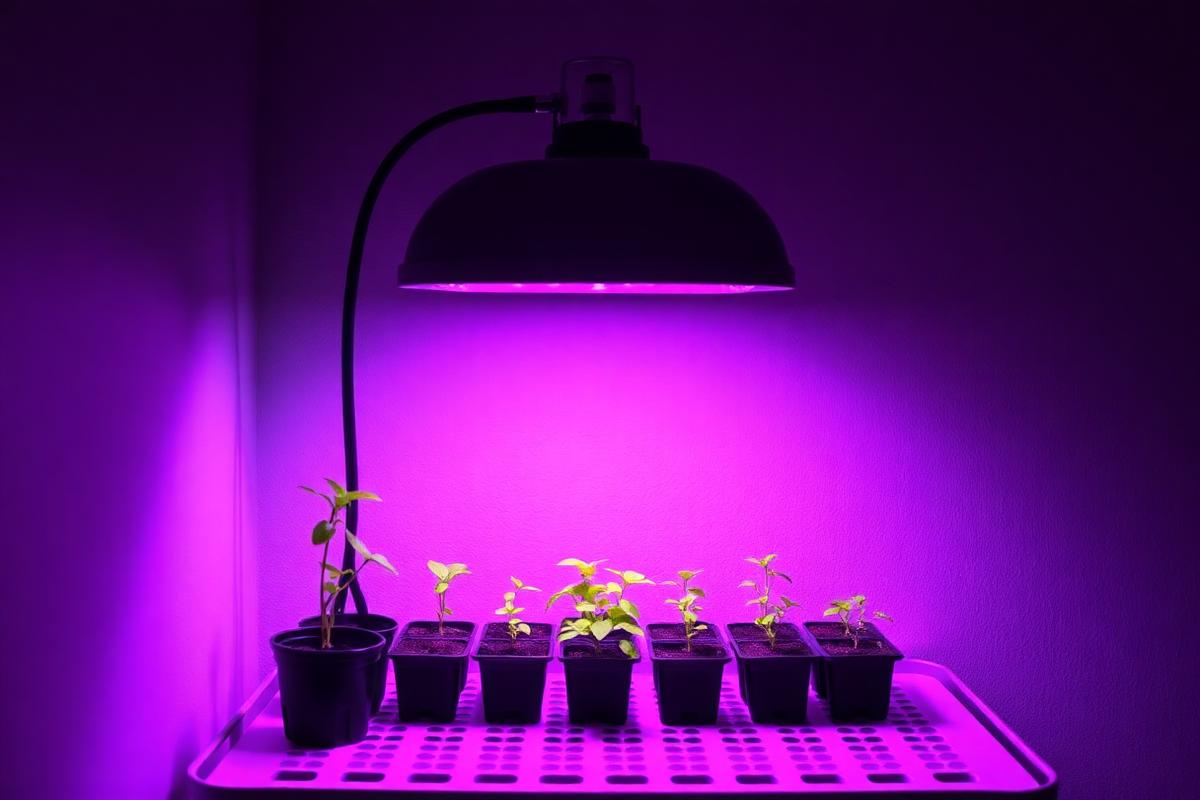
Older grow lights used red + blue diodes (the "blurple" look) because those wavelengths drive the strongest photosynthetic response per photon. They work, but they make the room unpleasant to be in and they make it hard to spot pests or nutrient deficiencies on leaves.
Modern full-spectrum white LEDs (typically 3000 K or 4000 K with a few extra red diodes) produce nearly identical growth results, look like daylight, and let you actually see your plants. For home growers, white LEDs are the right default in 2026.
Practical fixture recommendations by space
Single shelf, herbs or houseplants: a 30–60 W LED bar mounted 30 cm above the canopy.
Small grow tent (60 × 60 cm), greens or seedlings: a 100–150 W full-spectrum panel.
Medium tent (90 × 90 cm), fruiting crops: a 240–320 W quantum-board style fixture from a reputable brand with published PPFD maps.
Key takeaways
- Watts measure electricity, not light plants can use. Ignore them when comparing fixtures.
- PPFD (μmol/m²/s) measures photons reaching the leaf — this is what you want on the spec sheet.
- DLI (mol/m²/day) tells you whether your plant will actually thrive, not just survive.
- Full-spectrum white LEDs (3000–4000 K) outperform purple "blurple" LEDs for almost every home grower.
Frequently asked questions
Do I need a UV or far-red light for houseplants?
No. UV and far-red have specific roles in flowering trials and tissue toughening, but they make no measurable difference for the houseplants and herbs most home growers care about. A good full-spectrum white LED is enough.
How high should I hang my grow light?
Follow the manufacturer's PPFD map. As a starting point: seedlings 45–60 cm, leafy greens and houseplants 30–45 cm, fruiting crops 20–30 cm. Watch the plants — leaf bleaching means too close, stretching means too far.
How many hours per day should I run grow lights?
Most houseplants and leafy greens do best with 12–16 hours of light, then a true dark period. Fruiting crops in vegetative growth want 16–18 hours. Always give plants 6+ hours of uninterrupted darkness — it matters as much as the light.
Related articles
More in Grow Lights & Equipment →
Optimizing Indoor Plant Light: The Verdant Hearth Guide to PAR Meters
Accurate light measurement is paramount for thriving indoor plants. This guide delves into PAR meters, explaining their crucial role in horticultural success and helping you choose the right device.

Demystifying UV Light for Indoor Plants: Benefits, Risks, & Safe Application
Ultraviolet light, often overlooked in indoor plant setups, plays a subtle yet profound role in plant development. Understanding its nuances can unlock a new level of vitality and resilience for your cherished greenery.

Optimizing Indoor Plant Growth: A Deep Dive into Light Cycle Timers
Harnessing the power of precision timing for your indoor garden's grow lights is not just about convenience; it's a fundamental aspect of mimicking natural light cycles and optimizing plant physiological processes. Understand how strategic light cycling can unlock your plants' full growth potential.

Optimizing Indoor Plant Environment: A Horticulturist's Guide to Precision Monitoring
Cultivating thriving indoor plants goes beyond basic watering and light. Achieving horticultural success hinges on understanding and precisely controlling your plant's environment, a task made simpler and more effective with the right monitoring tools.

Optimizing Your Indoor Garden: A Horticulturist's Guide to Smart Grow Light Timers
Precision in horticulture extends beyond nutrients and water; it encompasses the meticulous control of your plants' most vital resource: light. This guide delves into the world of smart grow light timers, offering you the tools to automate and optimize your indoor garden's illumination cycles with unprecedented accuracy and convenience.

Demystifying Oscillating Fans: Optimizing Airflow for Indoor Plant Health
Air circulation is a foundational, yet often overlooked, component of successful indoor plant cultivation. Beyond simply moving air, a well-chosen oscillating fan can transform your grow environment, influencing everything from disease prevention to plant vigor.